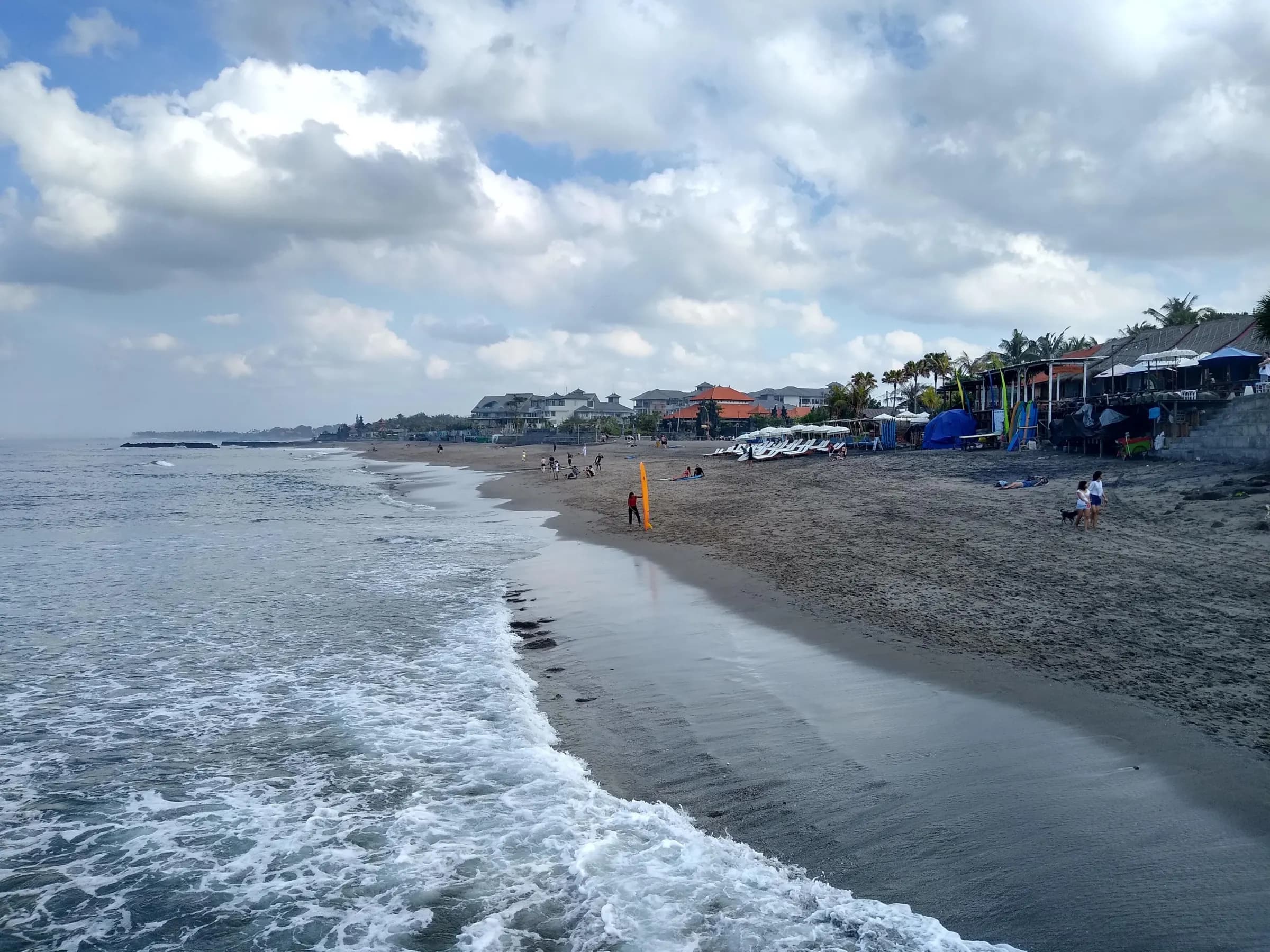
New to this? The list below opens with the famous waves, and they are not the ones for you. Start at Batu Bolong.
Batu Bolong
beginnerThe reason half of Canggu exists: soft, slow, rolling lines over a deeply covered rock shelf that stay gentle even when the swell is overhead. A surf camp's own guide calls it "very safe for first-time surfers" and notes that unlike Baby Padang on the Bukit there is no convenient channel to paddle out through. It is also, without exaggeration, one of the busiest learners' line-ups on earth.Padang Padang Surf CampIndonesian Surf Guide
Watch out: The crowd is the hazard, not the wave. Surf-school groups, ditched longboards and surfers riding without leashes share a small peak, and being hit by a board — yours or somebody else's — is the realistic way to get hurt here. A heavy shore pound forms on head-high and bigger days and makes getting in and out with a longboard genuinely risky. Water quality drops after heavy rain because road drainage empties into the line-up.
- Tide
- Mid to high, high tide cleanest — one guide says the low tide is a closeout fit only for riding whitewater straight in, another rates it as working on all tides. Assume high.
- Swell
- S/SSW/SW, roughly 1–5ft; holds shape to about head-and-a-half
- Wind
- Light offshore N to NE, which in practice means before about 10am
Old Man's (the peak north of Batu Bolong)
beginnerAbout 200 metres north across a channel, over deeper rock — so smaller, slower and less frequent than Batu Bolong, which makes it the better option as the swell builds. It has a proper channel to paddle out through, which Batu Bolong does not.Padang Padang Surf Camp
Watch out: Same as next door and for the same reason: loose and ditched boards in a beginner-heavy line-up. Less shore pound than Batu Bolong under normal conditions, and less affected by run-off than the breaks near the river mouths.
- Tide
- Mid to high; one guide prefers the lower tides when it is small
- Swell
- S/SSW/SW, waist-high to about 1.5x overhead
- Wind
- NE to E, offshore in the early morning
Berawa
improverA shifting sand-bottom beach break with two reef set-ups either side, in front of the big beach clubs. It is the natural next step after Batu Bolong and the one Canggu wave where you can walk south down the beach and find an empty peak. Sources split on the level: one spot guide rates the whole zone as suiting all abilities, the surf camp rates it intermediate and advanced. Treat the main sandbank as improver terrain and the reefs as not.Padang Padang Surf CampIndonesian Surf GuideSurf Atlas
Watch out: Loose boards again — this is where intermediates arrive from the beginner peaks. The Ledge, the low-tide right just south of the access road, is a shallow, fast, technical reef and is not an improver wave despite sitting on the same beach. Drainage from the main road runs straight into the south peak, so the water is worst there after rain.
- Tide
- Mid tide for the main peak — it fattens at high and closes out at low
- Swell
- S to SW, 1–5ft; best when overhead and the banks have lined up
- Wind
- NE to E; glassy early mornings or straight after a squall
Echo Beach (Batu Mejan) — the left
advancedNot a beginner wave, and the surf camp that teaches here says so in one word: "No, this is not a beginner-friendly wave." A short, punchy left over a shallow shelf with a steep take-off, one main peak and two or three turns before it runs into the channel. Black sand suspended in the water hides how close the bottom is.Padang Padang Surf CampIndonesian Surf GuideSurf Atlas
Watch out: Shallow reef immediately under the take-off, a rip current between the reef and the beach, and a line-up that fills the moment it is good. Your own board is the most likely thing to injure you, because the wave asks for late, hard turns. Submerged rocks near the stairs and seawall on the way in.
- Tide
- Genuinely disputed. The surf camp says mid to high, closing out at low. One spot guide says it only breaks on the higher tides. Surf Atlas says mid and low. Check a forecast and look at the water rather than trusting any of the three.
- Swell
- S to SW, roughly 1–5ft; bigger than that and it closes out
- Wind
- Light E to calm — it is a dawn wave in the dry season
Canggu Rivermouth
advancedThe best wave on this stretch and the one the visiting professionals surf: a wedging right that takes off over a submerged rock shelf and finishes over sand, barrelling from the take-off on bigger days. Rated intermediate-to-expert by the surf camp, with a heavy crowd, and it is a step up from anything else in Canggu.Padang Padang Surf Camp
Watch out: It breaks at the mouth of a river draining a densely populated catchment, so water quality is poor and gets worse after rain; the murk also hides a bottom that is closer than it looks. Rocks, and your own board, which the wave actively encourages you to surf harder than usual. Paddle out through the rip just south of the river, not across the shelf.
- Tide
- High, and it keeps working on an extreme high tide when the Bukit reefs are drowned
- Swell
- S/SSW/SW; works from knee-high, closes out around double overhead
- Wind
- No wind — this is a first-light or last-light wave
Pererenan
advancedQuieter and more upmarket than the Batu Bolong end, and still not a beginner wave — the surf camp's answer to whether beginners can surf it is a flat "No. The bottom is rock and reef, and the wave is punchy." It is honest about the quality too, calling Pererenan an "overflow wave" that people surf when the Rivermouth and Sandbar are packed a hundred metres away.Padang Padang Surf CampIndonesian Surf Guide
Watch out: A shallow rock shelf on the inside of the left — kick out early rather than ride it in. The take-off zone is small, so despite the thinner crowd the competition for it is sharp among residents who surf it daily. River current makes positioning shifty.
- Tide
- Sources disagree: the surf camp calls mid tide the sweet spot with high tide soft but surfable, while one spot guide says high tide only. Both agree low tide is too shallow to be worth it.
- Swell
- S/SSW/SW; best head-high to slightly overhead, closes out much beyond that
- Wind
- No wind; offshore in easterlies to northerlies